
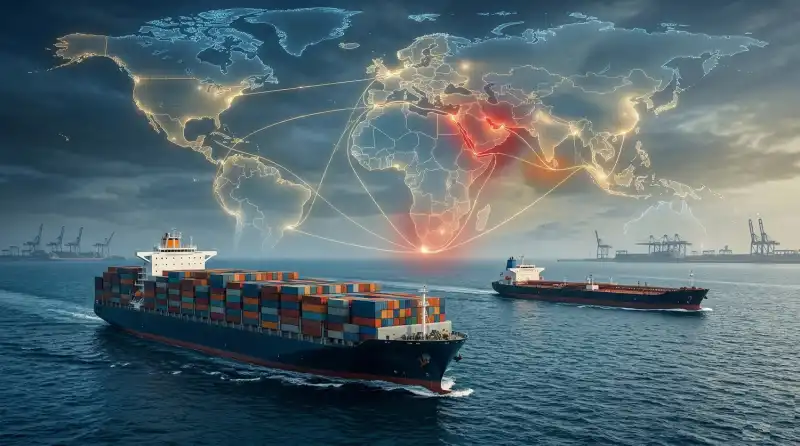
Shipping Under Pressure: How Global Disruptions Are Reshaping Trade Routes
Published: 06 March 2026 | Reading time: ~6–8 min | By: JAR Magazine Desk
Global shipping is once again under pressure. Trade does not move only on contracts and cargo bookings. It also moves on stability, predictable sea lanes, fuel costs, insurance conditions, and confidence. When any of these weaken, the effects spread quickly across freight markets, delivery schedules, and final consumer prices.
In recent years, the world has learned that maritime trade can be disrupted by more than port congestion alone. Conflict risk, sanctions, chokepoint insecurity, and policy uncertainty now play a major role in how ships are routed and how supply chains are planned. For importers, exporters, freight forwarders, carriers, and port agents, this is not just a news story. It is an operating reality.
Why trade routes matter so much
Sea routes are the hidden infrastructure of the global economy. A very large share of world trade still moves by sea, and certain narrow passages carry outsized strategic importance. When these routes become unstable, the impact is rarely local. It affects bunker costs, vessel availability, transit time, insurance premiums, warehousing plans, and inventory strategy across multiple countries.
That is why chokepoints such as the Strait of Hormuz, the Suez Canal corridor, and the Bab el-Mandeb area matter so much. A disruption in any of these locations can influence not only shipping schedules but also energy prices, manufacturing costs, and inflation expectations.
The Strait of Hormuz remains a global pressure point
The Strait of Hormuz remains one of the most critical energy transit routes in the world. A major share of seaborne oil moves through this narrow passage. If tension rises around the area, markets react quickly because the risk is not theoretical. Even the possibility of interruption can increase volatility in energy and freight markets.
For Asia in particular, this matters deeply. Large energy-importing economies depend on uninterrupted flows from the Gulf. If that flow becomes uncertain, buyers must think about price exposure, alternative sourcing, and delivery risk. Logistics professionals then face a second wave of pressure: adjusting schedules, managing customer expectations, and preparing for cost swings.
Red Sea disruption changed voyage economics
Another major lesson has come from the Red Sea. When vessels avoid risk zones and reroute around the Cape of Good Hope, the consequences are immediate. Routes become longer. More fuel is consumed. More days are added to each voyage. Vessel rotation becomes less efficient. Equipment availability can tighten. What looks like a routing change on a map turns into a chain reaction across the shipping system.
Longer voyages also affect reliability. Importers may face delayed replenishment. Exporters may lose timing advantages in competitive markets. Ports can face uneven congestion patterns as shipping lines redesign networks and service strings. Even companies far from the actual conflict zone may feel the shock through higher logistics costs and weaker schedule integrity.
Freight costs are no longer driven by demand alone
Freight pricing has become more complex. In the past, many businesses looked mainly at cargo volume, seasonality, and container availability. Today, route security, war risk, marine insurance, fuel shifts, and policy uncertainty all shape the market. That means freight decisions require broader judgment than simple rate comparison.
A low quoted rate may not remain low if the voyage becomes longer, if surcharges appear later, or if transshipment risk increases. Smart shippers now pay closer attention to the full logistics equation: transit time, reliability, rerouting risk, destination handling exposure, and the credibility of the service provider.
Why this matters for importers and exporters
For businesses involved in international trade, the new environment demands flexibility. Importers may need stronger buffer planning, more realistic lead times, and better communication with suppliers. Exporters may need to review delivery commitments, shipping terms, and customer promises more carefully. A rigid supply chain can quickly become an expensive one.
This is especially important for developing markets and trade-dependent economies. When shipping risk rises, smaller businesses often suffer first because they have less bargaining power, less warehousing flexibility, and less access to financial protection tools. That is why trade resilience is now becoming a competitive advantage.
The role of logistics partners is getting bigger
In uncertain times, logistics partners are no longer just booking agents. They become information partners, risk interpreters, and coordination managers. Businesses increasingly need forwarders, NVOCC operators, port agents, and supply chain advisors who understand not only rates, but also route strategy, documentation readiness, port conditions, and cargo-specific risk.
A strong logistics partner helps customers compare options clearly: direct service versus transshipment, speed versus cost, and short-term savings versus long-term reliability. In a disrupted market, that kind of decision support can protect both margins and reputation.
Trade route change is now a strategic issue
What we are seeing is more than a temporary disturbance. The geography of trade is being shaped by a mix of geopolitics, energy dependency, security concerns, and slower global growth. Some disruptions may ease, but the larger lesson will remain: businesses can no longer assume that traditional routes will always stay equally efficient or equally safe.
That means strategic planning must evolve. Companies should diversify risk where possible, maintain updated route intelligence, and build stronger operational communication between procurement, shipping, finance, and customer service teams. The winners in this environment may not be the firms with the cheapest logistics, but the firms with the most resilient logistics.
Final thought
Global trade still moves, even under pressure. But the map is becoming more fragile. Shipping disruptions, energy chokepoints, and geopolitical uncertainty are reshaping how cargo flows across the world. For businesses, the key question is no longer only how cheaply can we ship? It is also how safely, how predictably, and how sustainably can we keep moving?
In the years ahead, trade route awareness will become a core business skill. For the shipping and logistics sector, that creates both a challenge and an opportunity: those who can navigate uncertainty with clarity will become more valuable than ever.
Key Takeaways
- Global shipping is being reshaped by conflict risk, chokepoint pressure, and rerouting.
- The Strait of Hormuz remains critical for global energy flows and market confidence.
- Red Sea disruption has increased voyage distance, fuel use, and schedule uncertainty.
- Freight decisions now require risk analysis, not just rate comparison.
- Reliable logistics partners are becoming more important in global trade planning.
JAR WORLD SHIPPING LINE
⭐ JAR Group VerifiedShipping Agent | Corporate HQ
JAR HOUSE (1st Floor)
Middle Halishahar, Munshipara
Chattogram, Bangladesh
Part of the JAR Group ecosystem. Global services in shipping, logistics, trade and maritime recruitment.